With thanks to Omesh Shrestha and Pradip Lamichhane from silverlining.com.np
Imagine that you are taking your family to Nepal for some respite from the UAE heat and to stomp around some mountains. A detour via the country's largest data center is not the first place most people picture when they think of the Himalayas. Server halls and GPU clusters.
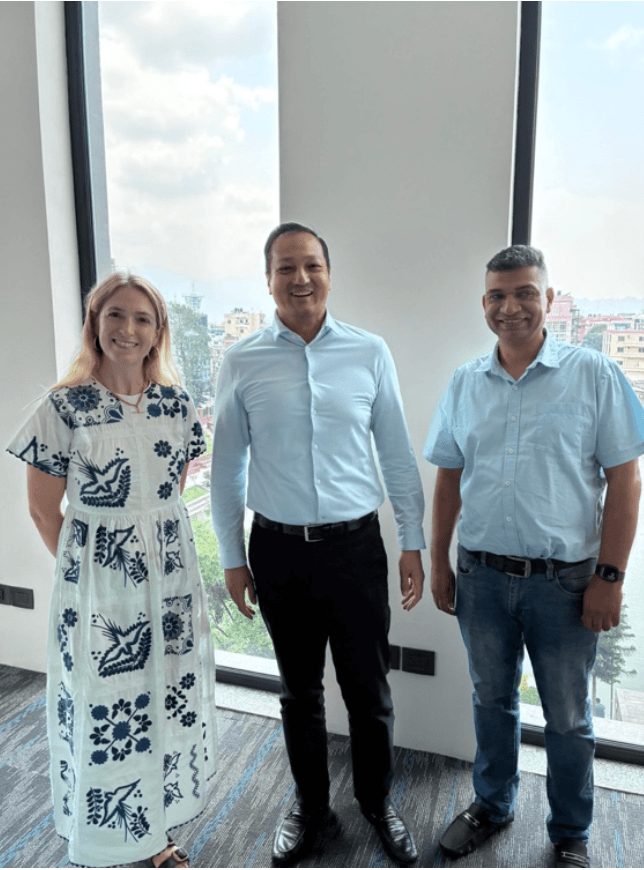
As I left my three children, six and under, in a safe office, away from their prying hands tinkering with any wires, my husband and I were able to view the data center with the brilliant SilverLining team. We were led past the rows of racks, the steady hum of the hot and cold containment cooling, the diesel generators standing ready out back, and somewhere between the security door and the machine room, you can look out at the rather marvellous view of the lowland Himalayas. Quite a contradictory, but incredible site.
When I mentioned to industry people and friends that I was visiting a data center in Nepal on our family holiday, most people were a bit perplexed. As immediately, their memories of Nepal may go back to the catastrophic 2015 earthquake, the chaotic melee of power cables, landslides, and beautiful yet dramatic mountains. Not necessarily a data center.
Nepal carries real risks for anyone building or operating critical infrastructure. But I also came away from my time on the ground very optimistic about the core fact that local knowledge goes a long way in driving success.
Thank you SilverLining for a truly eye-opening experience. They are building an exceptional AIaaS business.
The Immediate Risks
Seismic
Nepal sits along one of the most active fault lines in the world, and the 2015 Gorkha earthquake remains fresh in living memory. A major event can crack structures, sever fiber, and bring down the power lines a facility depends on. For a data center, where a few seconds or minutes of downtime is a serious matter, this is a serious concern.
Power Reliability
Nepal's grid is fed overwhelmingly by hydropower, a real advantage, but supply to a given site often comes from a single source, and the rules around how you connect are restrictive. A facility that loses its grid feed and has not planned for secure back-up will be exposed to hefty SLA penalties. That places a heavy premium on redundancy, on generators and uninterruptible power systems, and on designing for the day the grid does fail.
Connectivity
Nepal is landlocked, and its fiber routes run through its larger neighbours over difficult mountain terrain. There are fewer carriers than you would find in a coastal hub, and that means less route diversity and more concentration risk on the paths that do exist.
Local Climate
Monsoon rains and landslides interrupt roads and supply chains. None of this is surprising to an experienced engineer, but all of it has to be designed for from the outset rather than patched in later.
Risk Mitigation
For all of the risks mentioned, Nepal already has data centers that are up and running, and meeting their SLA targets, avoiding brutal revenue loss. The country's pioneering operators have been at this since around 2010, and the most advanced site I saw is AI-ready, built around modern GPU infrastructure, and engineered to withstand a severe earthquake, Richter Scale 9. (The 2015 earthquake was magnitude 7.8.) It holds uptime that would stand comparison with facilities anywhere, on infrastructure from the same vendors a Western operator would specify. It does have N+N, albeit there is only one power supply in the country, which limits resilience.
Nepal's power is close to entirely hydroelectric, which makes it one of the cleaner grids in the region, and it is available at a few cents per kilowatt hour, among the most competitive clean power anywhere. The country generates a growing surplus of that power, and the highland climate offers cooler ambient conditions than much of South Asia. For workloads that are hungry for energy, with less pressure for latency, Nepal is a good option.
If you understand and see the risks, you can cost and design to mitigate them. From the seismic exposure to the grid restrictions, knowing these hurdles drives the design. The best people to help solve the challenges are the people on the ground, the people who know the place.
Physics. Priced.
To price the risk of a data center project in Nepal, you must first work with the locals. These are the engineers who have operated through an earthquake and a monsoon and who will build seismic resilience and power redundancy into the foundations. The discipline is to scale cautiously: start with building IT capacity to meet demand, prove the resilience in real conditions, and expand in step with power availability and genuine demand rather than racing ahead of either.
The Opportunity
It is about seeing the risks instead of wishing them away, and in return building infrastructure to last, giving investors return on equity.
Nepal has set out to become a hub for data centers and AI, and recent reforms have opened a clearer path for foreign investment.
It is a wonderful country with genuinely charming people. It is well worth the visit, and we will of course be visiting again.
Key Takeaways
- Nepal has operational, AI-ready data centers engineered for Richter Scale 9 seismic events
- Hydroelectric power at a few cents per kWh, one of the cleanest, cheapest grids in the region
- Single power supply in country is the binding resilience constraint
- Landlocked connectivity requires carrier diversity planning from day one
- Local expertise is non-negotiable: operators with earthquake and monsoon experience are the risk mitigation